Tax residency: when does Spain have the right to tax you?
Spend more than 183 days in any calendar year in Spain and you become a tax resident (residente fiscal), with an obligation to file a return with the Agencia Tributaria. That threshold sounds straightforward, but it determines which country holds taxing rights over your pension income.
The Netherlands and Spain have a tax treaty — the 1971 agreement was replaced by a new treaty that entered into force on 1 January 2023. Under the new treaty the default rules are:

- AOW and comparable social-security pensions remain taxable in the source country — the Netherlands.
- Private pensions and annuities are generally taxable in the country of residence — Spain, once you are a Spanish tax resident.
- Government pensions (ABP, municipal or other public-sector schemes) remain taxable in the Netherlands, unless you hold Spanish nationality.
In practice, a retired civil servant or teacher receiving both an ABP pension and AOW continues to pay tax on both in the Netherlands even after relocating to Spain. Someone whose only pension is a private occupational scheme will pay Spanish income tax (IRPF). Spanish rates run from 19% on the first band (up to approximately €12,450) to 47% above approximately €300,000, with the exact bands depending on the autonomous community. The Comunitat Valenciana and Andalusia each apply their own regional surcharges.
Modelo 720 and the overseas-asset declaration
As a Spanish tax resident you are required to declare foreign assets above €50,000 using the Modelo 720. This covers bank accounts, real estate and investment portfolios held outside Spain. Failing to file carries penalties; the form itself has no direct tax consequence, but it forms the basis for subsequent compliance checks. File the Modelo 720 by 31 March of the year following your first year of Spanish tax residency.
The annual income-tax return (IRPF) is filed on Modelo 100, submitted between April and June for the preceding tax year.
Purchase costs for new-build in Spain: the actual percentages
New-build transactions are subject to VAT (IVA) at 10% of the purchase price rather than transfer tax (ITP). On top of that, allow for:
- Stamp duty (AJD): 0.5–1.5% depending on the region (Comunitat Valenciana: 1.5%; Andalusia: 1.2%).
- Notary fees: approximately 0.1–0.5% of the purchase price, depending on the complexity of the deed.
- Land registry fee: approximately 0.1–0.3%.
- Lawyer's fees: 1% is the standard rate; some lawyers charge a fixed fee of €2,000–€4,000.
For new-build, budget a total of 12–13% on top of the purchase price in additional costs, excluding any mortgage costs.
A NIE (Número de Identificación de Extranjero) is mandatory before you can sign a purchase deed. You can apply at the Spanish embassy in the Netherlands or at a Spanish Oficina de Extranjeros; allow two to six weeks for processing.
Oasis 004 — Benissa, Costa Blanca Norte
Oasis 004 is a four-bedroom villa in Benissa, priced at €2,250,000. Benissa is on the Costa Blanca Norte, roughly 30 kilometres north of Benidorm and 60 kilometres from Alicante airport. At this price point, wealth tax (Impuesto sobre el Patrimonio) becomes relevant for buyers who become Spanish tax residents: the Comunitat Valenciana applies a personal allowance of €500,000, above which rates of 0.25% to 3.5% apply to net wealth.
The Gallery — Ojén, Costa del Sol
The Gallery in Ojén comprises four- to five-bedroom villas priced from €3,400,000 to €4,250,000. Ojén is approximately 8 kilometres from Marbella and around 65 kilometres from Málaga airport. From 2023, Andalusia replaced its regional wealth tax with the national Solidarity Tax on Large Fortunes (Impuesto de Solidaridad de las Grandes Fortunas), which applies to net wealth above €3,000,000 at rates of 1.7% to 3.5%. Buyers at this level should take advice from a gestor or tax adviser with specific experience in cross-border situations before completing.
Villas en Hondon de las Nieves — La Canalosa, Costa Blanca interior
Villas en Hondon de las Nieves in La Canalosa are three-bedroom villas priced at €410,000. La Canalosa is inland in the province of Alicante, approximately 40 kilometres from Alicante-El Altet airport and roughly equidistant from the coast. At this price, total new-build purchase costs (10% IVA + AJD + notary + registry + lawyer) realistically amount to €49,000–€53,000 on top of the purchase price. This price range is also accessible for buyers purchasing without a mortgage: a cash purchase in Spain is procedurally simpler and completes faster than a financed one.
Camarate Hills III — Buenas Noches, Costa del Sol West
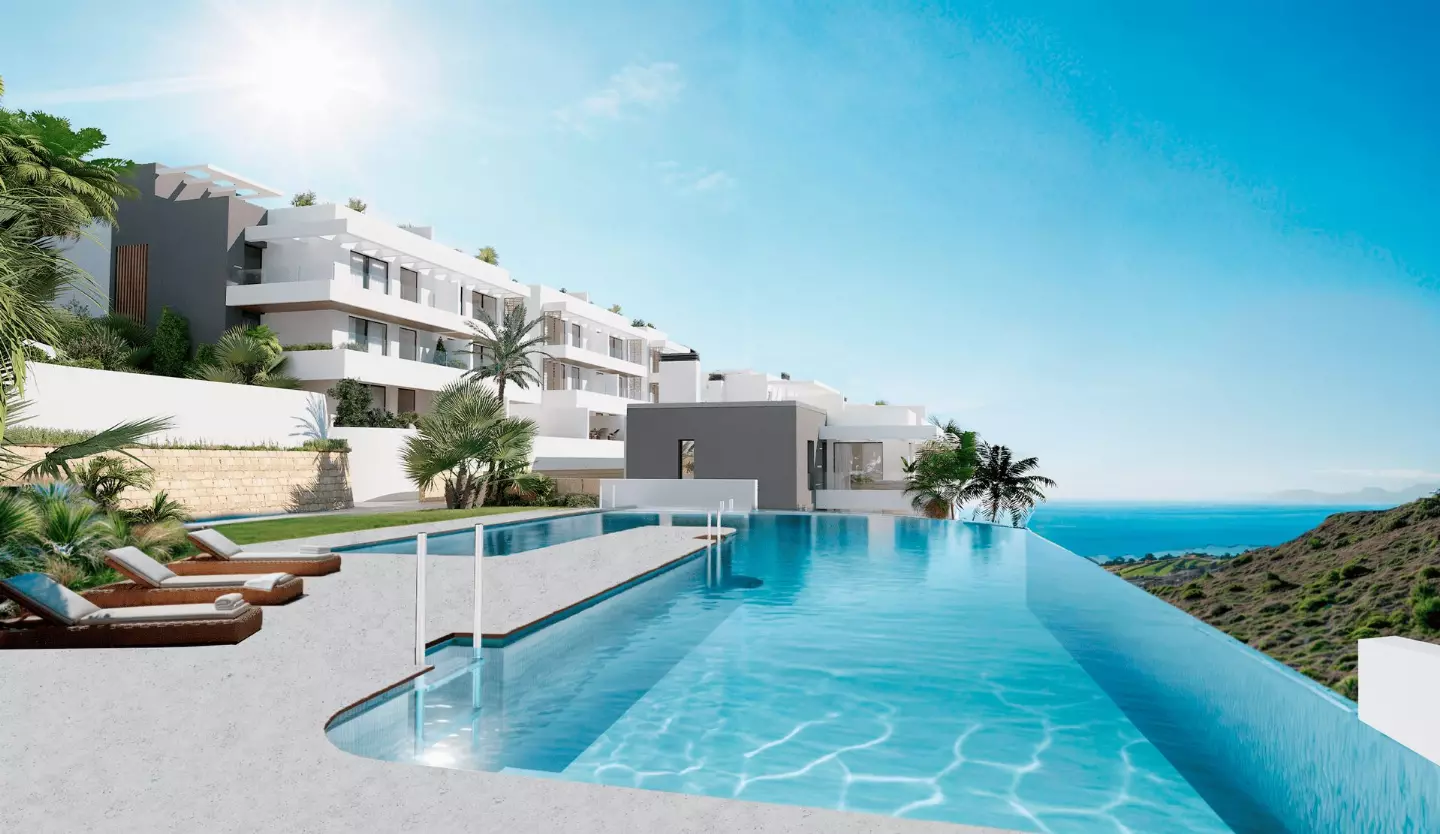
Camarate Hills III in Buenas Noches offers single-storey homes, apartments and penthouses with one to three bedrooms, from €245,000 to €525,000, with a communal swimming pool. Buenas Noches is a residential area near Estepona on the western Costa del Sol. For buyers who rent before purchasing and later become Spanish tax residents, it is worth noting that rental income from a Spanish property is taxed as income under IRPF; non-residents declare rental income using Modelo 210.
Talasa Caelus Fase I - II — El Verger, Costa Blanca Norte
Talasa Caelus Fase I - II in El Verger is a three-bedroom townhouse with a private pool, priced at €493,000. El Verger is approximately 10 kilometres south of Dénia and around 90 kilometres from Alicante airport. Off-plan purchases — where the property is still under construction — require a bank guarantee (aval bancario) covering all stage payments made before completion. This is a statutory requirement under Spanish Law 57/1968 and its successor legislation; always verify that the guarantee is issued per payment tranche, not solely for the total amount.
Practical steps for retiring buyers
- Obtain a NIE — no purchase deed can be signed without one.
- Open a Spanish bank account; payment from a foreign account is legally possible but notaries generally prefer a Spanish account for the final settlement.
- Instruct an independent lawyer (abogado) to review all purchase contracts — including the nota simple from the land registry, which shows any debts and encumbrances registered against the property.
- Before you move, discuss with a tax adviser which type of pension you receive and in which country it will be taxed after emigration; the answer has a direct bearing on your net income and any Spanish IRPF liability.
- Take account of Spanish inheritance tax (Impuesto sobre Sucesiones y Donaciones): the Comunitat Valenciana and Andalusia both offer relatively favourable allowances for direct family members, but the rules vary by region and are not equivalent to Dutch inheritance law.